Facet Arthritis Treatment in Castle Rock
What is Facet Arthritis?
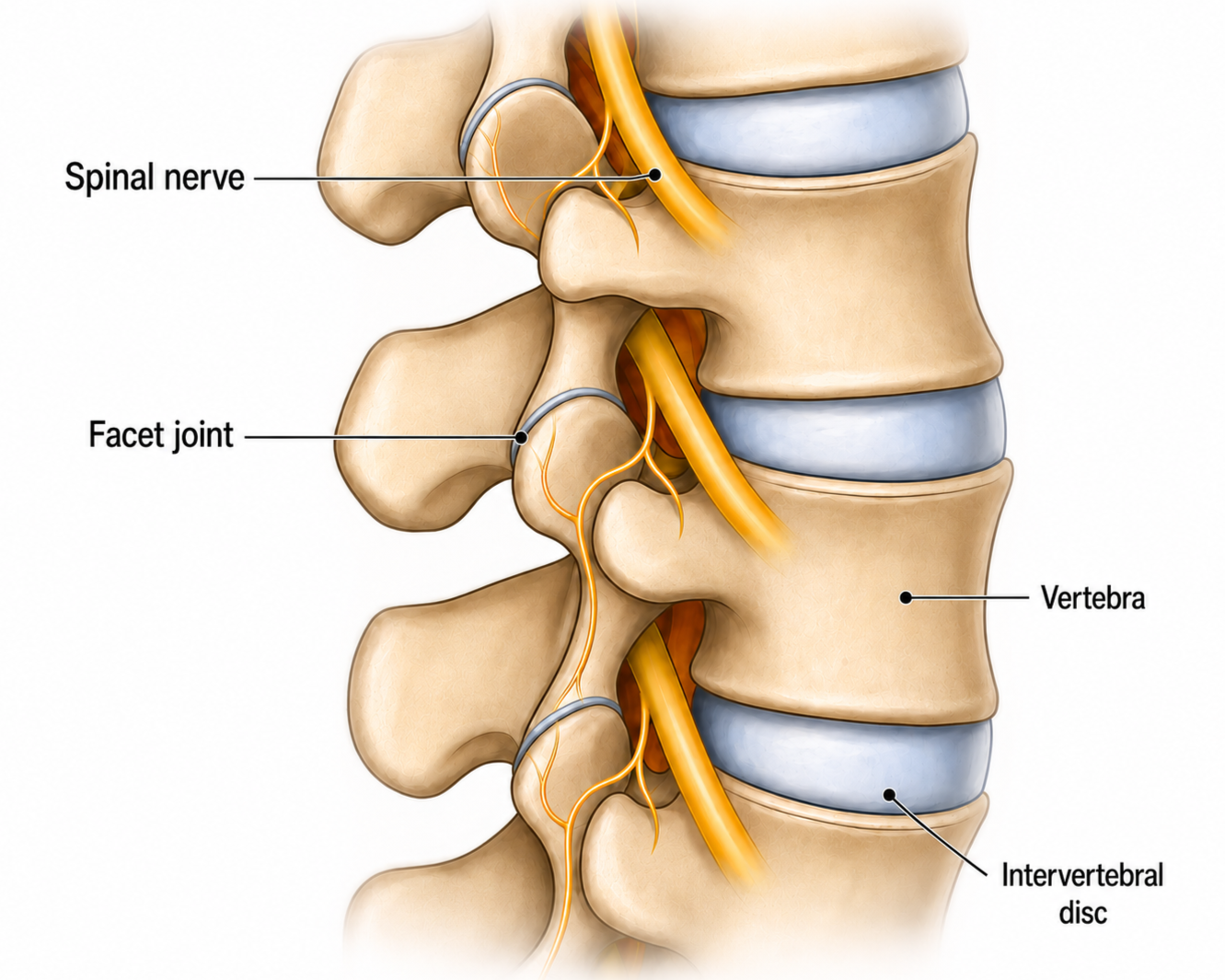
Facet arthritis (also called facet joint syndrome or spondylosis) is degeneration of the facet joints - the small paired joints along the back of the spine that connect each vertebra and allow the spine to bend and twist. Like any joint, facet joints can develop arthritis over time as cartilage wears down, bone spurs form, and the joint becomes inflamed.
Facet arthritis is one of the most common causes of chronic neck and back pain in adults over 40. It is frequently present alongside other conditions like degenerative disc disease and spinal stenosis, which makes accurate diagnosis important - treating the wrong pain generator will not provide relief.
What Does Facet Arthritis Feel Like?
Aching pain in the neck or back that is worse with extension (leaning back) and twisting
Pain that is worse with prolonged standing or after periods of inactivity
Stiffness in the morning or after sitting for a long time
Pain that improves with forward bending or changing positions
Pain that stays in the neck, upper back, or lower back - facet pain typically does not radiate far down the arm or leg (unlike a pinched nerve)
Tenderness when pressing on the spine over the affected joints
In the cervical spine (neck), facet arthritis can also cause headaches at the base of the skull. In the lumbar spine, it can cause pain that refers into the buttock or upper thigh, which is sometimes mistaken for sacroiliac joint dysfunction or sciatica.
What Causes Facet Arthritis?
Aging: The most common cause. Cartilage wears down over decades of use.
Disc degeneration: As discs lose height, the facet joints bear more load and degenerate faster.
Previous injury: Whiplash and other spine injuries can damage facet joints and accelerate arthritis.
Repetitive extension and rotation: Activities that involve repeated arching of the back or twisting.
Spondylolisthesis: When a vertebra slips forward, the facet joints at that level take on abnormal stress.
How is Facet Arthritis Diagnosed?
Diagnosis starts with your history and physical exam. Facet arthritis has a characteristic pattern: pain with extension and rotation, tenderness over the facet joints, and pain that does not follow a nerve pattern. MRI or CT can show facet joint changes (enlargement, bone spurs, joint fluid), though imaging alone does not confirm facet joints as the pain source - many people have facet changes on imaging without symptoms.
The most definitive way to confirm facet-mediated pain is with a diagnostic injection. Facet joint injections place steroid directly into the joint and can confirm the diagnosis if pain improves. Medial branch blocks numb the nerves that carry pain signals from the facet joints and are used to determine candidacy for radiofrequency ablation (RFA).
How is Facet Arthritis Treated?
Physical therapy: Core stabilization, postural training, and flexion-based exercises reduce load on the facet joints and are a foundation of treatment. Extension-heavy exercises should generally be avoided.
Medications: Anti-inflammatory medications (NSAIDs like meloxicam) can help during flares. Topical anti-inflammatory gels (diclofenac) may provide localized relief. Muscle relaxants are sometimes used for associated muscle spasm.
Facet joint injections: Steroid injected directly into the arthritic facet joint reduces inflammation and can provide relief lasting weeks to months. These injections are also diagnostic - if they help, they confirm the facet joint as the source. More on the facet joint injection page.
Medial branch blocks and radiofrequency ablation (RFA): For patients with confirmed facet-mediated pain, this is the pathway to longer-lasting relief. Medial branch blocks are diagnostic injections that numb the nerves supplying the facet joints. If two blocks are successful, radiofrequency ablation uses heat to disrupt those nerves, providing 6 to 18 months of relief per treatment. This pathway can typically be completed within 4 to 6 weeks.
PRP: Platelet-rich plasma injections into facet joints are available as a steroid-free alternative for patients who prefer to avoid repeat steroid injections.
Schedule an Evaluation
If you have chronic neck or back pain that is worse with leaning back or twisting, facet arthritis may be the source. Dr. Carrera's team can evaluate your symptoms, review imaging, and determine whether facet-targeted treatment is the right approach.
Written by Eduardo Carrera, MD Double board-certified in Interventional Pain Medicine and Physical Medicine & Rehabilitation
Dr. Carrera completed his entire medical training at the University of Colorado — medical school, PM&R residency, and pain management fellowship — and serves as an oral examiner for the American Board of Physical Medicine and Rehabilitation. He practices in Castle Rock, Colorado, where he treats spine, joint, and nerve pain using diagnostic injections, nerve ablation, and other non-opioid procedures. More about Dr. Carrera →