Radiofrequency Ablation (RFA) in Castle Rock
What is Radiofrequency Ablation?
Radiofrequency ablation (RFA), also called radiofrequency neurotomy or rhizotomy, is a procedure that uses heat to temporarily disable small nerves that carry pain signals from arthritic joints to the brain. By interrupting these signals, RFA can provide months of relief from chronic neck, back, or knee pain without surgery, implants, or ongoing medications.
RFA is one of the most effective non-surgical treatments available for facet joint pain. In about 75% of patients, it provides at least 50% pain reduction for six months or longer. Average relief lasts about eight months, and many patients experience over a year of benefit per treatment.
How Does RFA Work?
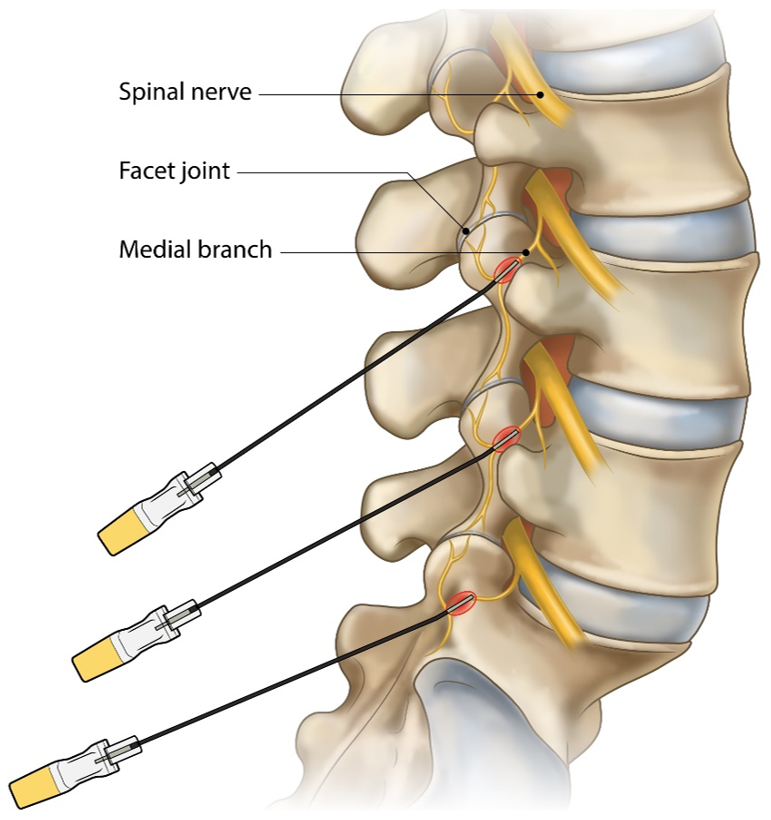
During the procedure, a specialized needle with an electrode tip is placed near the medial branch nerves that supply pain sensation to the affected facet joints. Radiofrequency energy is delivered through the electrode, generating controlled heat that disrupts the nerve's ability to transmit pain signals. The nerves gradually regenerate over time, which is why the procedure may need to be repeated every 6 to 18 months.
What Conditions Does RFA Treat?
Chronic neck pain from cervical facet arthritis
Chronic low back pain from lumbar facet arthritis
Whiplash-related neck pain that persists after the initial injury has healed
Knee osteoarthritis (genicular nerve RFA)
Persistent knee pain after knee replacement surgery
Do I Need Medial Branch Blocks Before RFA?
Yes. Before performing RFA, Dr. Carrera's team first performs medial branch blocks (MBBs) - diagnostic injections that temporarily numb the same nerves that will be ablated. This confirms that those specific nerves are the source of your pain. Most insurance companies require two successful MBBs on separate days before approving RFA.
The team schedules both blocks efficiently, usually within one to two weeks of each other, so there is no unnecessary delay. The full pathway from initial evaluation through RFA can typically be completed within 4 to 6 weeks. More information is available on the medial branch block page.
How Should I Prepare?
Before the procedure, let the team know about all medications you take, especially blood thinners and anti-inflammatory drugs. You may need to stop certain medications temporarily. Because the RFA procedure uses IV sedation, you will need to avoid eating or drinking for several hours beforehand. Arrange for someone to drive you home.
What Happens During the Procedure?
You will lie face down on a procedure table. IV sedation is administered, which creates a relaxed, drowsy state - patients often compare it to feeling like they have had a couple of drinks. You are not fully asleep, but most patients remember very little of the procedure afterward. About half of patients have no memory of it at all.
Using fluoroscopy (live X-ray), the provider places specialized needles near the medial branch nerves. Mild electrical stimulation is applied to confirm the needles are in the correct position by checking your motor responses. Once correct placement is verified, radiofrequency energy is delivered to each nerve. The entire procedure takes about 20 to 30 minutes depending on how many nerves are treated.
How Much Does It Hurt?
Because the procedure is performed under IV sedation, most patients experience little discomfort during the ablation itself. Pain during the procedure is typically rated between 4 and 6 out of 10, with brief moments that may reach 7 out of 10 - but the sedation keeps most patients relaxed enough that they tolerate it well and often do not remember these moments afterward.
Post-procedure soreness at the treatment sites is common and usually resolves within a few days to two weeks.
Stryker Venom Needles
Dr. Carrera's team uses Stryker Venom needles for radiofrequency ablation. These are specialized needles designed to create a larger treatment area around each nerve, which significantly increases the likelihood of capturing the nerve and producing meaningful pain relief. Most practices use standard needles, which create a smaller treatment zone and may miss the nerve. The Stryker Venom needles come at no additional cost to you.
What Should I Do After RFA?
Avoid strenuous activities for at least 24 hours. Most patients take it easy for a few days.
Soreness at the treatment sites is normal and can be managed with over-the-counter pain relievers and ice.
Gradually resume normal activities based on comfort.
For neck ablations, expect a mild sunburn-like sensation for a few days and possibly a numb patch where you previously felt neck pain. This can last several weeks and is a sign the procedure worked.
When Will I Feel Better?
Full pain relief from RFA can take one to two weeks to develop, and in some cases up to six weeks. It is normal to experience increased soreness for several days before the relief kicks in. This is different from injections, which typically provide faster relief - RFA works by disrupting the nerve over time, not by reducing inflammation immediately.
How Long Does the Relief Last?
Most patients experience 6 to 18 months of relief per treatment, with an average of about 8 months. Because the treated nerves gradually regenerate, repeat procedures are expected. RFA can be repeated as often as every six months if needed. Most insurance plans require documentation of at least three to six months of relief before approving another ablation.
Does Insurance Cover RFA?
Yes. Most insurance plans, including Medicare, Medicaid, and commercial insurers, cover RFA when criteria are met. These include chronic pain for at least three months, failure of conservative treatments, imaging (usually MRI), and two successful diagnostic medial branch blocks. The team handles all prior authorization in-house.
The Full Treatment Pathway
For patients with chronic facet joint pain, the typical path from evaluation to RFA looks like this:
Evaluation with Dr. Carrera's team - review of imaging, physical exam, and treatment history.
First medial branch block - diagnostic injection to test whether the targeted nerves are the pain source.
Second medial branch block on a separate day - confirms the result.
Radiofrequency ablation - if both blocks are successful, RFA is scheduled for long-lasting relief.
This entire process typically takes 4 to 6 weeks at Dr. Carrera's office. At many practices, patients wait months just to begin the first step.
Schedule a Consultation
If you have had temporary relief from medial branch blocks and want longer-lasting results, radiofrequency ablation is the next step. Dr. Carrera's team can walk you through the process and get you scheduled.
Written by Eduardo Carrera, MD Double board-certified in Interventional Pain Medicine and Physical Medicine & Rehabilitation
Dr. Carrera completed his entire medical training at the University of Colorado — medical school, PM&R residency, and pain management fellowship — and serves as an oral examiner for the American Board of Physical Medicine and Rehabilitation. He practices in Castle Rock, Colorado, where he treats spine, joint, and nerve pain using diagnostic injections, nerve ablation, and other non-opioid procedures. More about Dr. Carrera →