Medial Branch Block in Castle Rock
What is a Medial Branch Block?
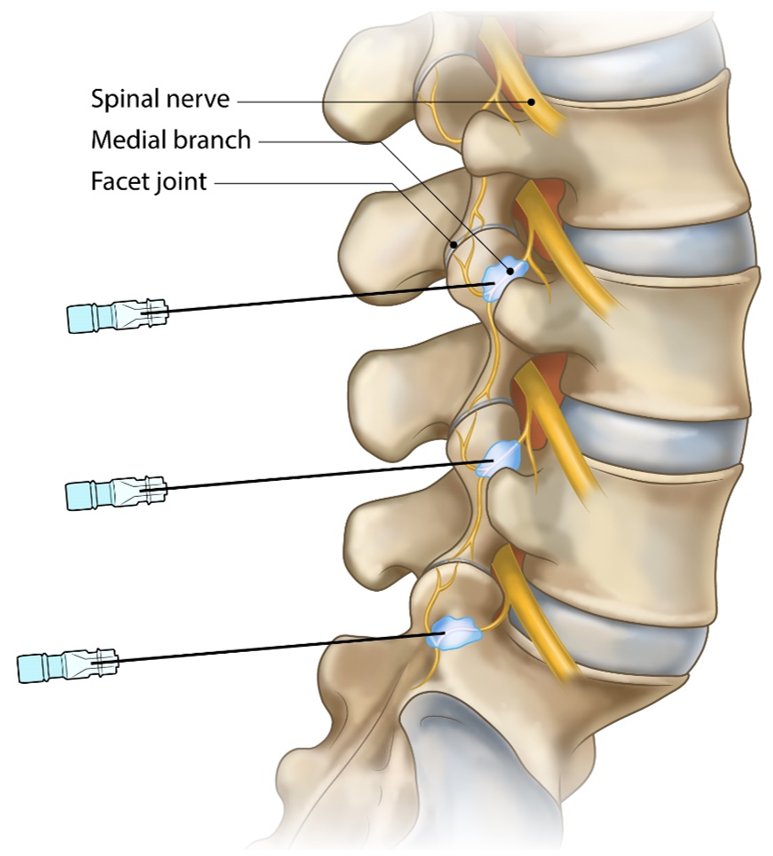
A medial branch block (MBB) is a diagnostic injection used to determine whether a specific facet joint is causing your neck or back pain. Medial branch nerves are small nerves that carry pain signals from the facet joints to the brain. By temporarily numbing these nerves with a local anesthetic, Dr. Carrera's team can identify which joints are responsible for your symptoms.
If the block significantly reduces your pain, it confirms that the targeted facet joint is the source. This information is used to plan the next step in treatment, which is usually radiofrequency ablation (RFA) - a procedure that provides longer-lasting relief by disrupting those same nerves. More information about RFA is available on the radiofrequency ablation page.
How is a Medial Branch Block Different from a Facet Joint Injection?
Patients often confuse these two procedures because both are used for facet-related pain. The difference is in what is being targeted.
A facet joint injection places steroid medication directly into the joint itself to reduce inflammation. It is both diagnostic and therapeutic - it can relieve pain for weeks to months.
A medial branch block targets the nerves outside the joint. It uses only a numbing agent (no steroid) and is primarily diagnostic. The goal is to confirm the pain source so your provider can recommend the most effective long-term treatment. If the block confirms facet joint pain, radiofrequency ablation of those same nerves typically provides 6 to 18 months of relief per treatment.
Your provider will recommend one approach or the other based on your specific situation, imaging, and goals.
What Conditions are Diagnosed with Medial Branch Blocks?
Medial branch blocks are used to evaluate chronic pain from facet joint arthritis (spondylosis) in the cervical spine (neck), thoracic spine (mid-back), or lumbar spine (low back). They are also used for whiplash-related neck pain and post-surgical spine pain when facet joints are suspected as a contributing source.
How Should I Prepare for a Medial Branch Block?
There is minimal preparation required. Blood thinners do not need to be stopped for this procedure. If you are receiving IV sedation (which is rare for medial branch blocks), avoid eating or drinking for several hours beforehand. Wear comfortable clothing that allows easy access to your neck or back.
For neck procedures, arrange for someone to drive you home, as temporary dizziness or mild numbness can occur.
What Happens During a Medial Branch Block?
You will lie face down on a treatment table. After cleaning the skin, a local anesthetic is applied to numb the surface. Using fluoroscopy (live X-ray) for guidance, a thin needle is placed near the medial branch nerve. A small amount of numbing medication is injected, and the needle is removed. The entire procedure takes about 2 minutes.
How Painful is a Medial Branch Block?
Most patients rate the discomfort between 2 and 4 out of 10. The procedure uses very small needles and is one of the quickest injections done in the office. Many patients are surprised by how fast and straightforward it is.
What Should I Do After a Medial Branch Block?
After the injection, the team will ask you to move in ways that normally cause your pain. This is the diagnostic part - if the numbing medication significantly reduces your symptoms, it confirms the targeted nerve is the source.
Keep a pain diary for the rest of the day. Note your pain level before the block, immediately after, and over the following several hours. This information helps your provider determine whether the block was successful and whether to proceed with radiofrequency ablation.
Avoid strenuous activity for 24 hours. You can resume normal activities the next day.
Why Are Two Medial Branch Blocks Required?
Most insurance companies require two separate medial branch blocks on two different days before approving radiofrequency ablation. Each block must provide significant pain relief (typically at least 80%) to confirm the diagnosis. This two-step process ensures the correct nerves are being targeted before committing to the ablation procedure.
Dr. Carrera's team schedules both blocks efficiently, typically within one to two weeks, so there is no unnecessary delay in reaching the RFA step.
How Long Does Pain Relief Last from a Medial Branch Block?
Because the injection uses only a numbing agent (no steroid), the direct pain relief is temporary - usually a few hours. The purpose of the block is diagnostic, not long-term treatment. If the blocks confirm facet joint pain, radiofrequency ablation provides the longer-lasting relief, typically 6 to 18 months per treatment.
Does Insurance Cover Medial Branch Blocks?
Yes. Most insurance plans, including Medicare, Medicaid, and commercial insurers, cover medial branch blocks when certain criteria are met. These typically include chronic pain lasting at least three months that has not responded to conservative treatments like physical therapy, activity modification, and medications. An MRI is usually required before authorization.
The team handles prior authorization and insurance verification in-house so your referring provider's office does not have to manage that process.
The MBB-to-RFA Treatment Pathway
For patients with chronic facet joint pain, the most common treatment path looks like this:
Evaluation with Dr. Carrera's team, including review of imaging and physical exam.
First medial branch block to test whether the targeted nerves are the pain source.
Second medial branch block on a separate day to confirm the result.
Radiofrequency ablation (RFA) to provide longer-lasting relief if both blocks are successful.
This entire pathway - from initial evaluation through RFA - can typically be completed within 8 weeks at Dr. Carrera's office. At many practices, patients wait months just to reach the first step.
Schedule a Consultation
If you have chronic neck or back pain and want to find out whether the facet joints are the source, a medial branch block is the diagnostic step. This is the gateway to radiofrequency ablation, which can provide months of relief.
Written by Eduardo Carrera, MD Double board-certified in Interventional Pain Medicine and Physical Medicine & Rehabilitation
Dr. Carrera completed his entire medical training at the University of Colorado — medical school, PM&R residency, and pain management fellowship — and serves as an oral examiner for the American Board of Physical Medicine and Rehabilitation. He practices in Castle Rock, Colorado, where he treats spine, joint, and nerve pain using diagnostic injections, nerve ablation, and other non-opioid procedures. More about Dr. Carrera →